Analyzing Python Code for Security Vulnerabilities: A Comprehensive Guide

When Versatility Meets Vulnerability
Python's popularity as a versatile, high-level programming language has made it a staple in web development, data science, automation, and AI applications. However, this widespread adoption also makes Python applications frequent targets for security attacks. Attackers exploit Python's ecosystem because of its extensive use in critical systems (e.g., web frameworks like Django and Flask), or machine learning libraries, like TensorFlow. According to recent analyses, Python's built-in interpreter can be leveraged in attack chains for sophisticated exploits, and its dynamic nature often leads to overlooked vulnerabilities. What's more, the open-source PyPI repository (hosting over 700,000 packages as of January 2026) is a prime vector for supply-chain attacks, where malicious packages mimic legitimate ones in order to infiltrate systems.
Common security pitfalls unique to Python stem from its design features. Dynamic typing allows for flexible code, but can hide type-related errors that lead to injection attacks or data leaks. The reliance on third-party libraries introduces dependency risks, and a single vulnerable package can compromise an entire application. Other issues include misuse of powerful functions, like eval() and exec(), which enable arbitrary code execution, and insecure handling of user inputs in web apps, leading to SQL injection or cross-site scripting (XSS). Reports highlight that outdated dependencies and weak input validation accounted for a large number of Python-related breaches in 2025. Addressing these requires a proactive approach to code analysis that blends tools, best practices, and vigilance. Let's look at two types of techniques: static and dynamic.
Static Analysis Techniques
Static analysis examines source code without executing it, identifying potential vulnerabilities by parsing syntax, data flows, and patterns. It works by building an abstract syntax tree (AST) or control flow graph, then applying rules to flag issues (like insecure function calls or hardcoded secrets). This method is efficient for early detection in the development lifecycle because it allows for a deep, automated analysis of code structure, saving time later when fixing bugs becomes more complicated.
There are a few tools that work for this. Bandit, Semgrep, and PyLint are three decent ones:
A linter is a static code analysis tool that examines source code without running it to detect bugs, programming mistakes, stylistic issues, and questionable constructs. It acts as an automated, real-time "second pair of eyes" to uphold coding standards, enhance readability, and avert potential runtime errors before the code is deployed.
Dynamic Analysis Techniques
Dynamic analysis complements static methods by testing code at runtime, uncovering issues like memory leaks or race conditions that only manifest during execution. Strategies include fuzzing (inputting random data to crash or expose flaws), interactive testing (manual probing), and runtime instrumentation (monitoring execution paths).
For Python, tools like Atheris (Google's fuzzer) adapt AFL for Python code, ideal for testing input-handling functions. Pytest, with security plugins, such as pytest-vuln, enables automated runtime checks. DynaPyt allows writing custom dynamic analyses to track taint propagation or modify values. Hypothesis, a property-based testing library, generates test cases to stress code boundaries.
In practice, fuzz a function like this with Atheris:
import atheris

def vulnerable_function(data):
    # Hypothetical vulnerable code
    eval(data.decode('utf-8'))  # Dangerous!

atheris.Setup([sys.argv[0]], vulnerable_function)
atheris.Fuzz()
This reveals crashes from malformed inputs. Integrate into CI with pytest for repeatable dynamic tests, focusing on APIs or user-facing components.
Dependency & Supply-Chain Security
Dependencies are a major risk in Python, as vulnerabilities often enter via PyPI through typosquatting or compromised packages. In 2025, incidents like the Ultralytics YOLO compromise affected thousands, injecting malware via AI libraries. It's no secret that supply-chain security issues have been on the forefront of security for several years now, and Python is no exception.
Audit tools include pip-audit for scanning requirements against known CVEs, Safety for CLI-based checks, and OSV-Scanner for broader vulnerability databases. Snyk and Trivy provide enterprise-grade SCA with reachability analysis to prioritize exploitable issues.
Secure Coding Practices
Secure coding starts with robust input validation. Use libraries like Pydantic for schema-based checks:
from pydantic import BaseModel, validator

class UserInput(BaseModel):
    query: str

    @validator('query')
    def no_injection(cls, v):
        if ';' in v:  # Basic SQL injection check
            raise ValueError('Invalid input')
        return v
Avoid dangerous functions: Replace eval() with safer alternatives, like ast.literal_eval(). For subprocess, use subprocess.run with shell=False to prevent command injection.
Manage configurations securely via the secrets module or environment variables, not hardcoded files. Always use virtual environments (venv) to isolate dependencies, reducing attack surfaces.
Code Review Strategy
Manual code reviews involve systematically inspecting code for security flaws, focusing on data flows and external interactions. Start by tracing user inputs to sinks, like databases or OS calls.
Common red flags: Use of eval/exec, unvalidated inputs, hardcoded credentials, or insecure deserialization (e.g., pickle). Search for patterns, like os.system without sanitization.
Pair with automated tools: Run Bandit first to flag issues, then review manually.
Tips: Use checklists based on OWASP, involve peers for diverse perspectives, and integrate into pull requests via tools like CodeQL.
Real-world Examples
A typical vulnerability in web apps is SQL injection. Here's an example of flawed code:
import sqlite3

def get_user(username):
    conn = sqlite3.connect('users.db')
    cursor = conn.cursor()
    query = f"SELECT * FROM users WHERE name = '{username}'"
    cursor.execute(query)  # Vulnerable to input like ' OR '1'='1
    return cursor.fetchall()
Here, the SQL query is built using string interpolation (f"...") with untrusted user input (username). That means whatever the user supplies is inserted directly into the SQL statement. An attacker can craft input that changes the meaning of the query.
This allows database dumps.
Corrected:
def get_user(username):
    conn = sqlite3.connect('users.db')
    cursor = conn.cursor()
    cursor.execute("SELECT * FROM users WHERE name = ?", (username,))
    return cursor.fetchall()
Using parameterized queries prevents injection.
Let's look at another one with my favorite Python modules: pickle. Take a look at this code:
import pickle

def load_data(file):
    with open(file, 'rb') as f:
        return pickle.load(f)
"Pickle" is a great name, isn't it? It's not great at security, though, as pickle.load() doesn't just load data, it also executes code embedded in the serialized object. If the pickle file comes from an untrusted or attacker-controlled source, loading it is equivalent to running attacker-supplied Python code.
In other words, an attacker can craft a malicious pickle payload that runs system commands when unpickled.
deserialization = execution with pickle.
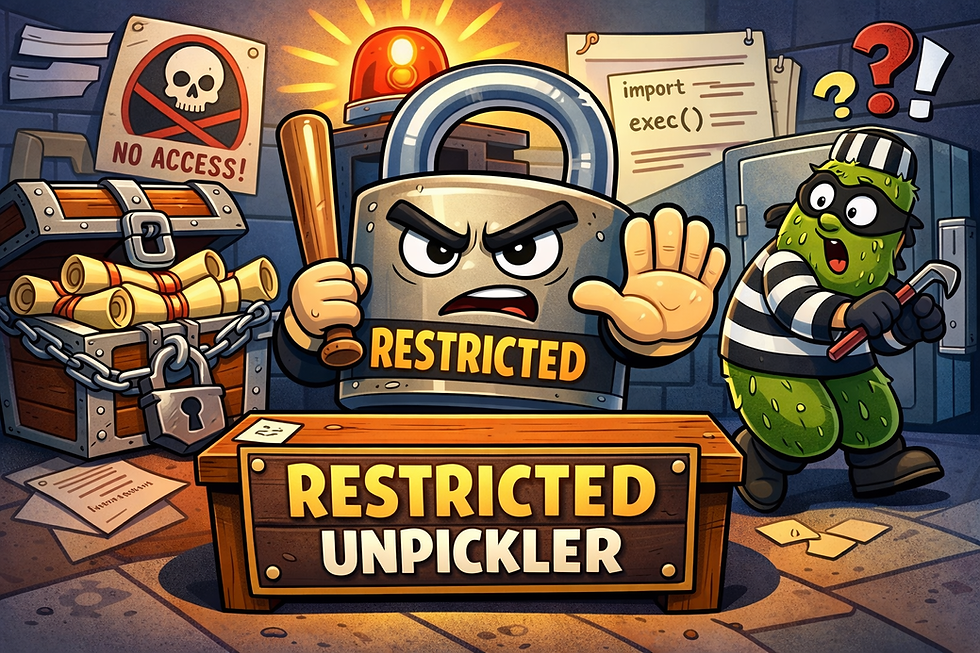
What's the fix? Use safer formats like JSON, or validate with RestrictedUnpickler.
Modern Best Practices
Shift-left security embeds checks early in development. In DevSecOps, integrate SAST (Semgrep), DAST (ZAP for runtime), and SCA (Snyk) into pipelines. Use Git hooks with pre-commit:
repos:
- repo: https://github.com/PyCQA/bandit
  rev: '1.7.5'
  hooks:
  - id: bandit
This scans on commit. Automate with tools like Jit for continuous monitoring. In 2025, AI-driven fixes in tools like Mend.io accelerate remediation.
Conclusion
Key takeaways: Combine static and dynamic analysis with secure coding to mitigate Python's unique risks. Tools like Bandit and pip-audit are essential, but manual reviews and DevSecOps integration ensure comprehensive coverage.
Continuous monitoring matters because threats evolve. But by prioritizing security, developers safeguard applications, maintaining trust and resilience in an increasingly hostile digital landscape.


Comments